A Seven-Seat XPENG for Australian Families
Seven seats, a third row that folds flat at the touch of a button and a published WLTP range of up to 580 km: that is the short version of the X9, the ultra intelligent seven-seater MPV in XPENG's Australian line-up. Families usually come to this size of car for the weekly logistics of people and gear, then leave a showroom unsure how the car behaves when every seat is taken. The published numbers answer more of that than most buyers expect.
Key takeaways
- The X9 is listed as an ultra intelligent seven-seater MPV with WLTP range up to 580 km.
- Its third row folds flat electrically, and cargo space expands to 2554 L.
- The submerged trunk design is described as fitting seven suitcases with all seats occupied.
- Scheduled maintenance runs on a 12-month or 20,000 km interval, whichever comes first.
Why a third row changes the shape of a week
Two adults and two children rarely need seven seats. Add grandparents, a cousin staying for a term, or a school carpool rota and the arithmetic turns quickly. A five-seat car forces a second trip, and a second trip on a Tuesday afternoon is the thing parents actually pay to avoid.
The X9 approaches the problem as a people mover rather than a stretched wagon. Under the published specification it is a seven-seater MPV on an 800V silicon carbide platform, which is the same high-voltage architecture the Australian pages describe for the New G6 coupé SUV. That shared platform matters later, when you are standing at a public charger on the way to a holiday house with a full load on board.
What a buyer should take from the specification is narrower than the marketing suggests. Seven seats is a genuine capability; seven seats plus luggage is the harder question, and it is answered by the way the boot is designed rather than by the seat count.
Boot space with all seven seats in use
Most three-row cars solve the luggage problem by making you choose between passengers and bags. XPENG describes a submerged trunk design for the X9 that fits seven suitcases with all seats occupied, which is a useful claim to test with your own cases rather than the showroom demo set.
When you are not carrying the full complement, the one-touch electric fold-flat third row turns the car into something closer to a van. Cargo space then expands to 2554 L, a figure that is easier to grasp if you think in terms of a folded pram, a week of groceries and a set of golf clubs sharing the same floor without stacking.
Take the published 2554 L as the expanded figure it is. Ask the dealer for the measurement with the third row in use, because that is the number that governs a Saturday morning with five passengers and a full boot.
Published figures for the two family shapes
| Published item | X9 | New G6 |
|---|---|---|
| Body and seating | Ultra intelligent seven-seater MPV | Ultra smart coupé SUV |
| WLTP range | Up to 580 km | Up to 525 km |
| 10 to 80 per cent state of charge | 12 minutes | 12 minutes |
| 0 to 100 km/h, all-wheel drive | 5.9 s | 4.13 s |
| Cargo volume | Expands to 2554 L | Ask your dealer for the boot measurement |
Read side by side, the table makes the trade-off plain. The larger car gives up a little range against the coupé body, uses the same rapid-charge window, and gains the seats and the volume that a growing family books its weekends around. Both cars are covered by the same published ownership terms, which are where a family calculation usually goes wrong.
Ride comfort with a full car
Weight is the enemy of comfort. A seven-seater on a long weekend is carrying perhaps five or six people, luggage for all of them, and the towbar weight of whatever is on the back. XPENG fits the X9 with dual-chamber air suspension and an AI chassis, with ride height that adapts to speed and six levels of manual control.
The published detail that is worth knowing is how far ahead the system looks: the chassis is described as detecting obstacles up to 30 m ahead and pre-adjusting damping before the car reaches them. On a broken country road with a car full of tired children, that is the difference between one thump and a series of them.
Active rear-wheel steering is the other feature that earns its place in a family car. Long vehicles are awkward in shopping centre ramps and tight school pick-up lanes, and the published steering system is designed to reduce that. Book a test drive that includes a car park rather than an open road, and judge it there.
Worked example: five years of scheduled servicing
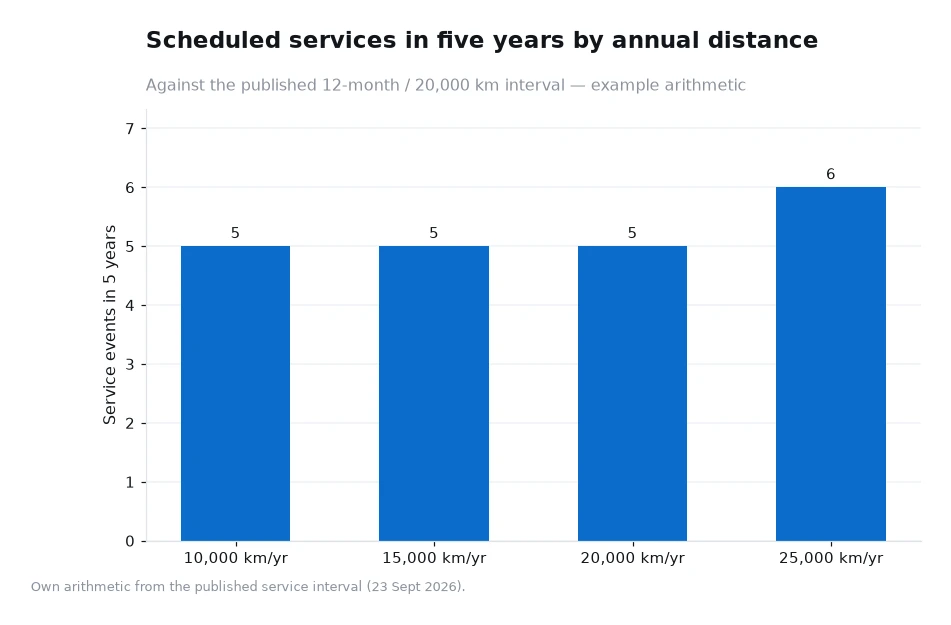
This is example arithmetic, not a manufacturer quote. The only published input is the service interval: every 12 months or 20,000 km, whichever comes first. Assume four different annual distances, and count the service events over five years.
At 10,000 km a year, the car covers 5 x 10,000 = 50,000 km in five years. Distance alone would trigger 50,000 divided by 20,000 = 2.5, so two events. The 12-month rule triggers five. Whichever comes first, so five services.
At 15,000 km a year, the distance is 5 x 15,000 = 75,000 km. Distance alone gives 75,000 divided by 20,000 = 3.75, so three events. The calendar still asks for five, so five services.
At 20,000 km a year, both rules coincide: 5 x 20,000 = 100,000 km, and 100,000 divided by 20,000 = 5. Five services either way.
At 25,000 km a year, the car covers 5 x 25,000 = 125,000 km. The distance rule needs 125,000 divided by 20,000 = 6.25 services, so the sixth falls inside the fifth year. Six services. No service pricing is published for the Australian market, so ask your dealer to quote for the schedule you expect to follow.
Charging a full car on the way to the coast
Office the published charging facts and a family trip becomes a scheduling exercise rather than a gamble. The X9 will accept DC fast charging on the CCS2 standard used across Australia and AC charging on Type 2, with the flap on the right rear quarter panel: press the top-left of the flap and the lid opens.
For a drive of two or three hours, the interesting number is the 10 to 80 per cent window in 12 minutes. A lunch stop and a charge stop can be the same 20 minutes, which is the real reason a family buys a car on this platform rather than a slower one. Treat the WLTP range as a test result and plan your first long trip with a margin, because load, speed, air conditioning and hills all take their share.
Some Tesla Supercharger sites in Australia are open to non-Tesla vehicles with CCS2 connectors, and the manufacturer's own guidance is to check the Tesla app for site compatibility before you rely on one, since not every site supports non-Tesla cars.
Frequently asked questions
Does the X9 fit seven people and their luggage at once?
The manufacturer describes a submerged trunk design that fits seven suitcases with all seats occupied, so the published claim is that it does. Test it with your own cases at the dealership, because the answer depends on how you pack.
How often does a seven-seat XPENG need servicing?
Scheduled maintenance is every 12 months or 20,000 km, whichever comes first, and XPENG recommends servicing through an XPENG Authorised Dealer. The exact work for each visit is set out in the owner's handbook and the XPENG ANZ Warranty and Maintenance Manual for Australia.
Planning the family test drive
Bring the car seats, the pram and the largest suitcase you own. Fold the third row, unfold it, and watch where the seat belts and the charging cable bag end up. Set the driver's seat, then sit in the second and third rows in turn, because a seven-seater is bought from the back as much as from the front.
The published specifications and ownership terms for the whole range sit on the manufacturer's Australian pages, including the model library for the XPENG electric suv australia line-up. Read the full X9 specification before you visit, then use Find a Dealer to book a car with the third row fitted.
Specifications, warranty terms and service intervals quoted here come from the manufacturer's Australian site (xpeng.com/au), read on 23 Sept 2026, and conditions and exclusions sit in the XPENG ANZ Warranty and Maintenance Manual for Australia. There is no published Australian pricing, so a dealer quote is the only firm number. [1]