Seasonal garden product orders succeed when assortment decisions, samples, production capacity, packaging, and transport are planned against a real market date. Start with the first required delivery, then add time for specification approval, production, inspection, document review, booking, and likely disruptions. Freeze high-impact choices early and assign an owner to every open item. A calendar with decision gates is more useful than a single optimistic ship date.
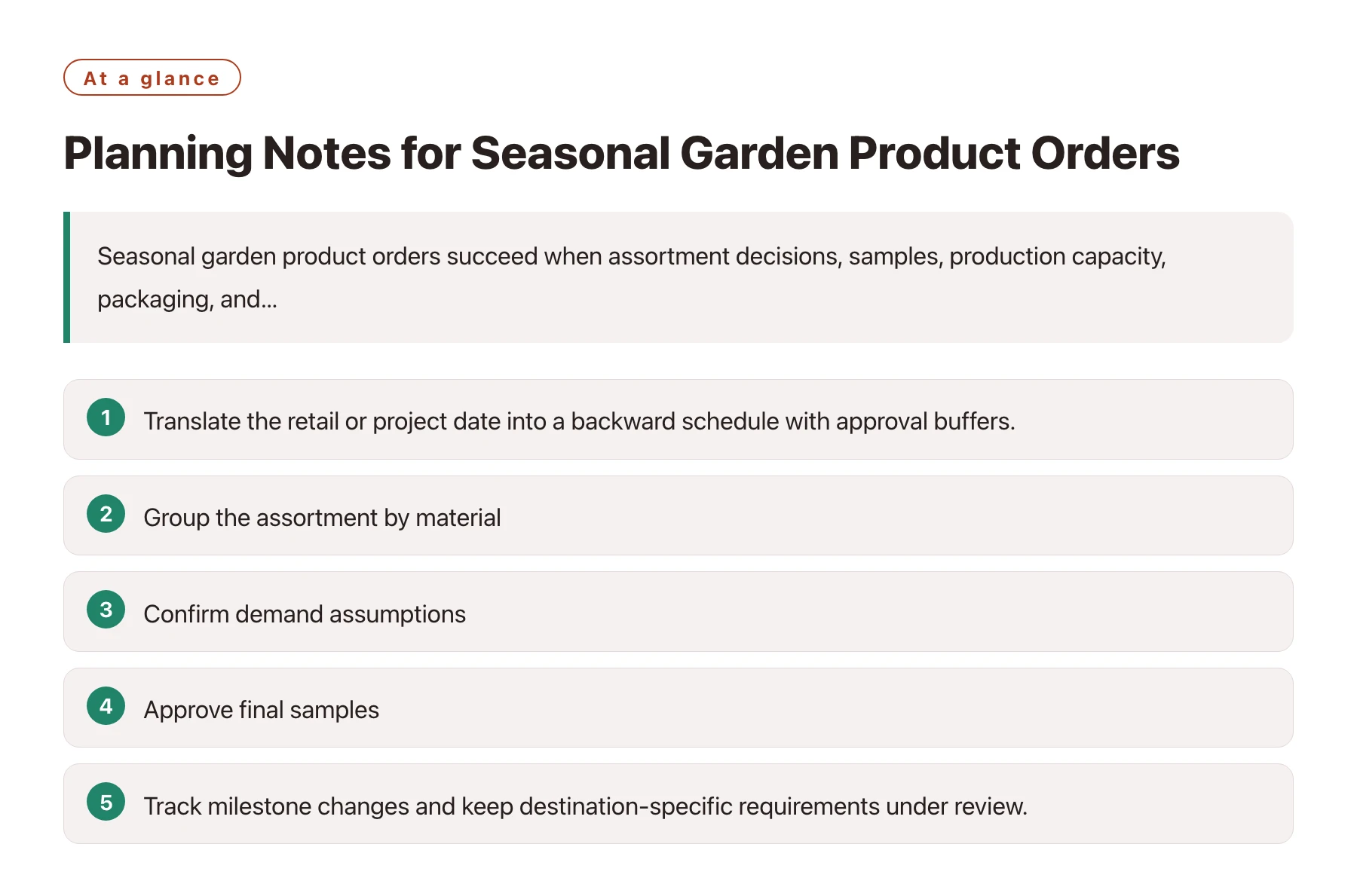
Key takeawaysTranslate the retail or project date into a backward schedule with approval buffers. · Group the assortment by material, production process, carton profile, and compliance needs. · Confirm demand assumptions, minimum order quantities, and variant-level forecasts. · Approve final samples, packaging, artwork, labels, and test evidence before production. · Track milestone changes and keep destination-specific requirements under review.
The plan should show what must be decided, who owns it, and the latest safe date for each decision.
1. Start with the market date and working backward
Identify the date when goods must be available for sale, installation, or a seasonal promotion. Work backward through receiving, customs clearance, transit, booking, final inspection, production, and sample approval. Ask suppliers for realistic production capacity and shutdown dates; do not treat a quoted lead time as a guaranteed door-to-door schedule. Add contingency where a missed vessel, rework, or delayed approval would make the product arrive after the selling window.
Mark decision deadlines separately from logistics milestones. A date for approving color, materials, carton artwork, or test evidence can be more critical than the production start shown on a quote. Use the supplier’s local calendar and confirm holidays, working days, and factory rest periods. Revisit the schedule when the assortment, order split, packaging, or destination changes.
2. Build a manageable assortment
Group products by material, construction, manufacturing process, finish, and packaging rather than treating every SKU as unrelated. Identify which variations share tooling or a production line and which require distinct components or tests. Keep a clear matrix of item code, description, color, size, material, quantity, carton configuration, and destination. This helps suppliers quote the same scope and helps buyers notice where a small forecast change affects a minimum order or production run.
Limit late additions that create new colors, sizes, or packaging versions without enough review time. For each optional item, record its forecast, price, minimum quantity, sample status, and latest inclusion date. If the order must be staged, decide how to divide core items and experimental variants so a popular line does not get delayed by a low-volume special finish.
3. Turn forecast into order quantities
Share the demand assumptions behind the forecast: comparable sales period, sales channels, regional climate, promotion dates, and any project commitments. Separate firm quantities from planning estimates and identify who may authorize an increase or reduction. A seasonal product can lose value quickly after its peak, so compare the cost of a stockout with the exposure of carrying leftover inventory. Where practical, model conservative, expected, and high-demand cases before committing to production.
Check supplier minimum order quantities, carton multiples, spare parts, and production batch sizes against each scenario. Ask whether replenishment is possible and what the real lead time would be after the first order. Confirm whether raw materials, components, or tooling must be reserved in advance. Put any flexible quantity range in writing, including the date at which the forecast becomes binding.
4. Approve product and packaging details early
Review a production-representative sample for dimensions, material, finish, function, color, assembly, and user-facing details. Record what the sample does and does not represent, including any unapproved component or finish. A sample approved for appearance does not automatically approve packaging, performance, safety, or a later material substitution. Freeze the bill of materials and revisions before mass production, and define how a proposed change returns for review.
Check packaging against the route and destination receiving conditions. Specify protection from moisture, abrasion, impact, corrosion, and deformation according to product material and handling. Confirm carton size, pallet pattern, weight, handling marks, and barcode or item labels. For seasonal products that may be stored before sale, agree any storage limits or assembly instructions that matter to product condition.
5. Map compliance and traceability by destination
Identify every destination country and intended product use before requesting declarations or labels. Requirements differ by product category and market; garden lighting, powered tools, furniture, chemicals, children’s goods, and simple planters may follow different rules. Assign a qualified compliance owner to determine applicable standards, testing, language, warnings, and importer responsibilities. Keep those obligations distinct from buyer preferences such as color, packaging style, and branding.
For consumer products placed on the EU market, the European Commission’s product safety information describes general obligations that include product safety and traceability considerations. The exact rule set depends on scope and product category, so verify the applicable legislation and current responsibilities with a qualified reviewer before approving a seasonal label or shipment. [1] Record model and batch identification, document references, and label revisions so a delivered lot can be connected to its evidence.
6. Coordinate production checkpoints and inspections
Set checkpoints for material confirmation, first production output, in-process review when risk warrants it, finished goods inspection, and shipment release. Define each checkpoint’s sample, evidence, acceptance criteria, owner, and action if it fails. For high-variation finishes, confirm what can be compared between lots and how the buyer will assess color or surface differences. Avoid scheduling an inspection before sufficient goods are finished and accessible.
Use findings to make a shipment decision. Record affected quantities, photographs, measurements, test results, corrective actions, and whether reinspection is required. If a delay threatens the selling window, compare options such as partial shipment, air freight for a small critical quantity, or dropping a low-priority variant. Each option changes cost and risk; obtain commercial approval rather than allowing a factory change to become an unrecorded assumption.
7. Protect the shipping and receiving window
Confirm booking milestones, ready date, container or consolidation plan, export documents, carton totals, and delivery address. Ask who is responsible for each document and when the final data must be supplied. Keep the packing list, commercial invoice, product schedule, and inspection disposition aligned. If the assortment is split across shipments, use identifiers that distinguish each shipment and show which items are expected in each delivery.
Prepare the receiving team for seasonal volume. Share the item and carton map, expected arrival range, storage needs, inspection priorities, and escalation contact. If goods must be distributed quickly to stores or project sites, agree how damaged or missing cartons are reported and how replacements are handled. The supplier’s departure date is only one milestone; receiving capacity and onward distribution can determine whether inventory is actually ready for the season.
8. Run a short weekly risk review
Use a one-page status view with milestone, planned date, forecast date, owner, status, blocker, decision needed, and next action. Highlight risks that can still be reduced: late sample approval, unconfirmed material, incomplete test evidence, capacity constraints, packaging changes, or uncertain freight. Escalate by the decision deadline, not only after a ship date has already slipped.
After the season, compare forecast with actual demand, delivery timing, defects, markdowns, and supplier performance. Keep observations specific to product, market, and order; one unusual season should not automatically become a universal forecast rule. Buyers working with Shanghai JS Sourcing can maintain a shared milestone and assortment record across supplier orders so changes reach procurement, quality, and logistics teams.
Sources
Frequently asked questions
When should a seasonal garden order be placed?
Work backward from the required market date and include sample approval, production, inspection, documents, booking, transit, receiving, and contingency. Confirm supplier capacity and local holidays before fixing dates.
How can buyers reduce leftover seasonal inventory?
Separate firm commitments from forecast ranges, compare multiple demand scenarios, and confirm replenishment lead time. Set a written date when flexible quantities become binding and review variant-level demand.
Should all garden products use the same compliance checklist?
No. Requirements can depend on product category, destination, intended use, and market. Have a qualified compliance owner map applicable rules and evidence for each distinct product group.
What should be checked before releasing seasonal goods?
Reconcile approved product and packaging revisions, inspection findings, quantities, labels, documents, shipment allocation, and receiving schedule. Close open deviations with an authorized decision before release.